The luteal phase is the stretch between ovulation and her period, about 14 days long. PMS lives at the end of it, so the week or two before her period is when she's most likely to feel irritable, tired, bloated or low. As her boyfriend, the most useful things you can do are know when it's coming, lower the load, and not take the mood personally.
I'm Geethika and I make Soleii, a period tracking app for couples, so I'm not neutral on this. The facts here come from Cleveland Clinic, ACOG, the NHS, the US Office on Women's Health and one clinical trial, all listed at the bottom and read on 3 October 2026. I'm not a doctor. The draft was written with AI and every claim was checked against those sources.
What is the luteal phase?
It's the last of the four phases of the menstrual cycle. Cleveland Clinic names them like this:
- Menstruation. Her period. Most people bleed for 3 to 7 days.
- Follicular phase. Starts on the first day of her period and runs to ovulation.
- Ovulation. An egg is released, around the middle of a 28 day cycle.
- Luteal phase. From ovulation until her next period starts.
Cleveland Clinic puts the average luteal phase at 12 to 14 days, and anything from 10 to 17 counts as normal. A whole cycle is usually 21 to 35 days, so the earlier phases stretch and shrink more than this one does.
Why she might be irritable before her period
Most women notice some premenstrual symptoms near the end of the luteal phase. Over 90% of women say they get some premenstrual symptoms, according to the US Office on Women's Health, and they tend to show up about a week or two before the period.
ACOG lists the emotional ones as irritability, angry outbursts, crying spells, anxiety, depression, poor concentration, trouble sleeping and wanting to be alone. The physical ones include bloating, tender breasts, headaches, food cravings, tiredness and skin problems.
So if she's shorter with you than usual that week, there's a real reason her body is making everything harder. That doesn't mean whatever she's annoyed about isn't real. Usually it is, and she just has less patience for it this week.
How to support your girlfriend in her luteal phase
Know when it's coming
PMS week is harder when it catches you both off guard. If you know her period is due in a week, a snappy reply reads differently. Ask her when it's due, or use an app she shares with you.
Lower the load before she asks
Do the evening chores. Keep plans small. Have food in the house she actually wants. None of it needs a speech.
Listen without fixing
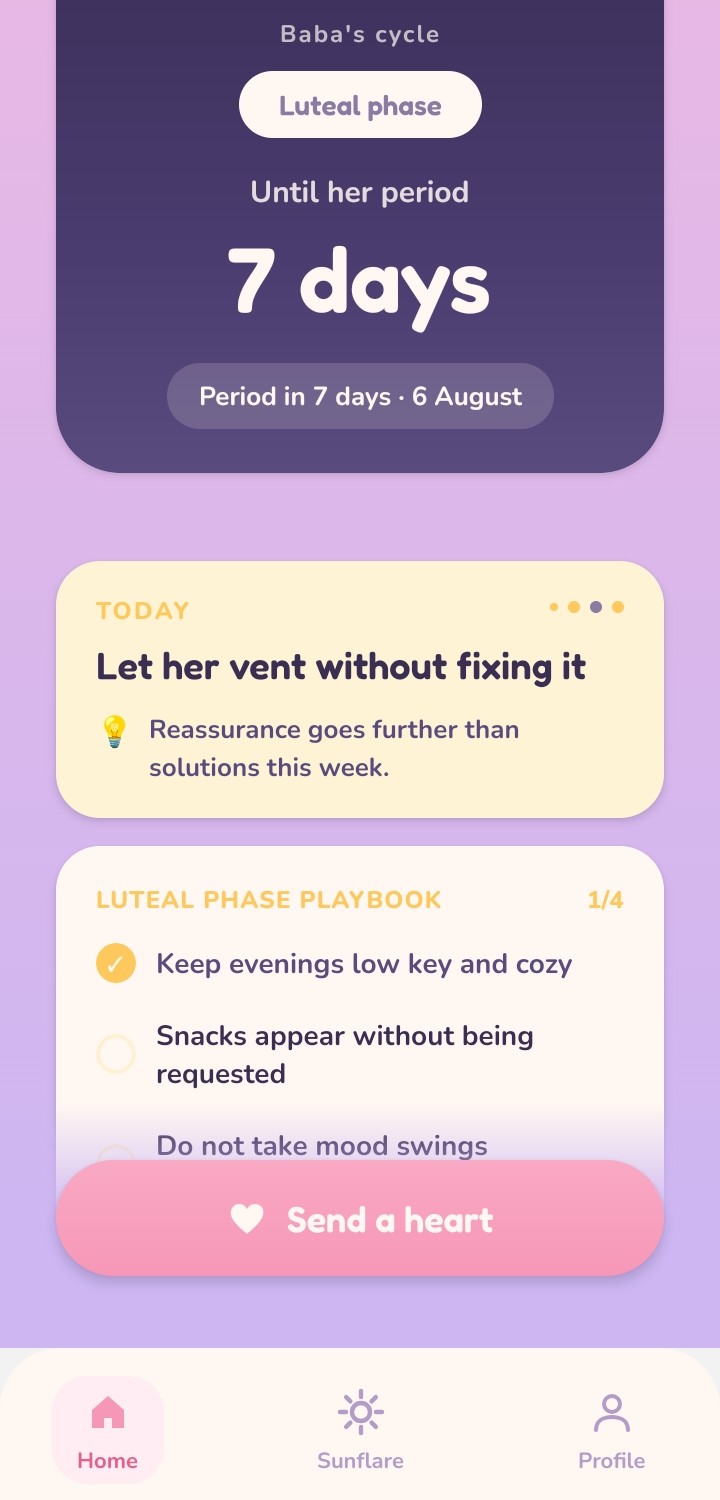
If she wants to vent, let her finish. Solutions can wait. Soleii's own playbook for this phase puts it as reassurance going further than solutions.
Don't argue about the big stuff this week
If something serious needs talking about and it isn't urgent, let it wait a week and pick a time you'll both hear each other.
Move together
ACOG says regular aerobic exercise eases PMS for many women, aiming for 30 minutes most days. A walk after dinner, together, counts. Invite her. Don't prescribe it.
Does it help when partners understand PMS?
There's real evidence that it does. In a 2017 trial in PLOS ONE, Ussher and Perz put women with moderate to severe premenstrual disorders into therapy with their partner, therapy alone, or a wait list. Of the 63 who finished, 84% of the couples group said they had more understanding and support around the premenstrual phase, against 39% for therapy alone and 19% on the wait list. An improved relationship with their partner came up for 57% of the couples group, 26% for therapy alone and 5% on the wait list.
It was a small therapy trial with no app involved. What it shows is that a partner who understands the premenstrual phase makes a difference she can feel.
When is it more than PMS?
PMDD is a severe form of PMS that can get in the way of work and relationships. The Office on Women's Health puts it at under 5% of women of childbearing age, and Cleveland Clinic says up to 10% of people who have periods. ACOG says that if PMS symptoms are severe and cause problems with work or relationships, it may be PMDD.
The NHS says to see a GP when lifestyle changes haven't helped or the symptoms are affecting her daily life. If she ever talks about hurting herself, that's urgent. In the US, call or text 988.
Questions people ask
How long does the luteal phase last?
About 14 days on average. Cleveland Clinic says 12 to 14 is typical and 10 to 17 is normal.
When does PMS start and stop?
Usually about a week or two before her period. The Office on Women's Health says symptoms go away within a few days after the period starts.
Why does she get mad at me before her period?
Irritability and angry outbursts are on ACOG's list of PMS symptoms. You're the person closest to her, so you're often the one who sees it. Don't argue the point that week. Come back to it later if it still matters.
Is the luteal phase the same as PMS?
No. The luteal phase is a stretch of the cycle every cycle has. PMS is a set of symptoms that often shows up near its end.
Should I tell her she's just PMSing?
No. Even when PMS is part of it, saying so dismisses what she's upset about. Notice it quietly and adjust what you do.
Can exercise help with PMS?
ACOG says regular aerobic exercise lessens PMS symptoms for many women, with at least 30 minutes most days as the goal.
How can I know which phase she's in?
Ask her, or share an app. Soleii shows the partner which phase she's in and how many days until her period, with a short list of what tends to help in that phase. It's on Android.
Soleii is a period tracking app for couples on Android. She logs her period, symptoms and mood. His phone shows which phase she's in, how many days until her period, a playbook for that phase and one clear thing to do today. Her daily logs never cross to his side.
Sources
- Cleveland Clinic, menstrual cycle
- Cleveland Clinic, luteal phase
- Cleveland Clinic, PMDD
- ACOG, premenstrual syndrome
- Office on Women's Health, premenstrual syndrome
- NHS, PMS
- Ussher and Perz (2017), couple CBT for premenstrual disorders, PLOS ONE